


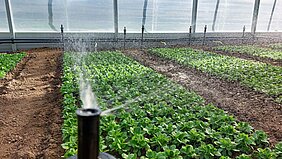
Periods of drought and rising water demand are making water reuse increasingly relevant in Germany as well. New EU regulations and the DWA information sheet M 1200 define clear quality standards for agricultural irrigation. In the BMBF project ‘Nutzwasser’ (utility water), a pilot plant with a multi-barrier approach shows how bacteria, viruses and antibiotic resistance can be effectively reduced. An important step towards sustainable and safe water resources!
Droughts, falling groundwater levels and rising water demand are also posing growing challenges in Germany. Water reuse offers a strategic opportunity to relieve pressure on freshwater resources and create locally usable alternatives – a practice that has been established in arid regions for decades.
EU Regulation 2020/741 defined minimum requirements for agricultural irrigation with treated water across Europe for the first time. These requirements have been transposed into German law since June 2023 and are supplemented by DWA leaflet M 1200. The regulations are based on risk-based quality classes and the validation of minimum log removal rates for bacteria, spores and viruses.
In the BMBF project ‘Nutzwasser’ (utility water), a pilot plant with multi-stage treatment (ceramic ultrafiltration, ozonation, activated carbon, UV disinfection) was investigated. The analysis showed a significant reduction in bacteria, viruses and antibiotic resistance. Spiking tests highlighted the different removal performances of individual processes, in particular UV and ultrafiltration. The pilot plant met the requirements of the EU regulation for quality class A.
No significant microbiological differences compared to drinking water were found when plants were watered with reused water. Contamination occurred regardless of the water quality used or the irrigation method (overhead vs. drip irrigation). This clearly shows that environmental factors such as soil, harvesting and handling have influenced the microbial contamination of vegetables.
Conclusion: The results confirm the effectiveness of the multi-barrier approach and the importance of risk-based quality management (QMRA). With our research, we are making an important contribution to safe and sustainable water reuse – a topic of high relevance for practice and future technical discourse in Germany.
Further information about the project can be found here on the project website-‘Nutzwasser’.
Further information can also be found in the following publications.
Ho, Johannes, et al. "Assuring reclaimed water quality using a multi-barrier treatment train according to the new EU non-potable water reuse regulation." Water Research 267 (2024): 122429.
Ahmadi, Javad, et al. "Rejection of viruses and mobile genetic elements by ceramic ultrafiltration membranes: impacts of operational conditions and implications for water reuse system performance validation." Water Reuse 15.3 (2025): 557-574.
Ho, Johannes, et al. "Microbial safety and antibiotic resistance of crops after irrigation with reclaimed water." Water Reuse 15.2 (2025): 300-318.