





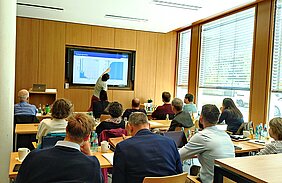
Two informational events on the Groundwater project ArNO held on May 21, 2026 (in Berlin) and June 11 (at the TZW in Karlsruhe). The aim of the project was a profound practical testing and evaluation of methods for assessing nitrate contamination in groundwater. The focus was particularly on historical nitrate inputs that have already been partially or completely attenuated in the groundwater.
The ArNO project is set against the backdrop of the current intense debate surrounding the revision of the so-called “red areas,” where strict fertilization regulations apply due to elevated nitrate levels. According to the Allgemeinen Verwaltungsvorschrift zur Gebietsausweisung (“General Administrative Regulation on Area Designation”, AVV GeA, 2022), in addition to measured nitrate concentrations, nitrate that has already been attenuated in groundwater must also be considered. Nitrate degradation (denitrification) reduces nitrate concentrations, meaning that the original nitrate input is no longer fully apparent from nitrate measurements alone. However, since the attenuation potential of nitrate is limited, it is important to account for denitrification when designating “red areas”.
This issue is addressed by the ArNO project which is shortly before its conclusion. The project held a series of technical events to inform water utilities and government agencies on the key findings to date:
- Suitability of monitoring sites and sampling requirements for determining nitrate input: To this end, the generally accepted technical rules for monitoring site design and sampling were explicitly examined regarding the analysis of nitrate and denitrification. Two fact sheets were developed and published based on the results (see project website in the info box).
- Hydrogeochemical indicators of potential denitrification: By analysing hydrogeochemical data from 229 groundwater monitoring sites in Baden-Württemberg, “hard” criteria and “soft” indicators of potential denitrification were identified. A further analysis of nearly 800 groundwater monitoring sites in Baden-Württemberg revealed the regions where denitrification can occur in groundwater. The results will soon be available on the project website.
- Challenges in regionalizing nitrate concentrations: Various regionalization methods -that is, methods for calculating areal data from point data - were applied to nitrate data and evaluated. The methods examined yielded good results in depicting areas of homogeneous nitrate distribution but also exhibited high sensitivity to isolated high nitrate concentrations. Methods that allow for a more precise analysis of spatial relationships, such as kriging, are preferable. By taking meta-information (e.g., the groundwater body) into account, greater fidelity to the measurement point can be achieved.
- Results of the project’s own sampling campaign on nitrate inputs and denitrification in groundwater: A one-year sampling campaign at selected groundwater monitoring sites demonstrated that nitrate concentrations attributable to denitrification generally exhibit only minor seasonal fluctuations. However, there are exceptions where it is therefore advisable to review the monitoring site, sampling procedures, and management practices in the vicinity of the monitoring site. At more than half of the monitoring sites, the concentration of degraded nitrate significantly exceeded that of nitrate still present in the groundwater.
- Trace organic contaminants as indicators of denitrification processes: The relationship between the presence of nitrate and trifluoroacetic acid (TFA), as well as their potential suitability as indicators of denitrifying sites, was investigated. An analysis of measurement data from the groundwater database revealed a correlation between agricultural land use, nitrate levels, and TFA levels. The monitoring sites sampled in the project provided evidence that high TFA concentrations combined with low nitrate concentrations may serve as an indicator of denitrification. However, for the practical application of TFA as an indicator, additional influencing factors—such as the impact of additional TFA input sources—must be considered.
The findings of the ArNO project to date clearly demonstrate the importance of taking denitrification in groundwater into account. To do so, it is essential to consider the requirements for monitoring sites and sampling, as well as the strengths and limitations of various regionalization methods. Hydrogeochemical criteria or, potentially, TFA can provide indications of possible denitrification. The lively discussion at the information events demonstrates that the consideration of already degraded nitrate is an issue that will continue to concern water suppliers, agriculture, and regulatory agencies for some time to come.
Further information on the project can be found here.
