


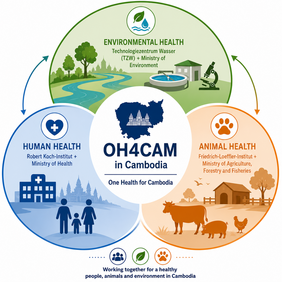
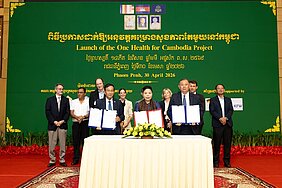
Within the new project OH4CAM – One Health for Cambodia, TZW collaborates with the Robert Koch Institute (RKI) and the Friedrich-Loeffler-Institut (FLI) to strengthen national One Health structures in Cambodia. The project aims to improve the prevention, early detection, and control of antimicrobial resistance, zoonotic diseases, and emerging infectious diseases. Funded by the German Development Bank (KfW) as part of international development cooperation, the project is implemented in close collaboration with Cambodian ministries.
The spread of antimicrobial resistance is one of the most pressing global public health challenges of our time. When disease-causing bacteria no longer respond to antibiotics, infections become increasingly difficult to treat. This leads to a higher risk of severe disease progression, prolonged illness, and increased mortality. The environment plays a critical role in both the dissemination and monitoring of antimicrobial resistance. Antibiotic-resistant bacteria, resistance genes, and antibiotic residues enter the environment through pathways such as municipal wastewater, hospital effluents, livestock production, and agricultural runoff. Environmental monitoring is therefore an essential component for identifying transmission pathways and improving our understanding of the spread of antimicrobial resistance.
Human, animal, and environmental health are closely interconnected, and antimicrobial resistance can circulate among these sectors through various pathways. The One Health approach brings these perspectives together and promotes coordinated surveillance, prevention, and response activities at the interface of human health, veterinary medicine, and monitoring of water and soil samples.
A One Health perspective is equally important for addressing zoonotic diseases and emerging infectious diseases. Factors such as climate change, land-use change, and increasing human mobility can facilitate their spread. Coordinated monitoring and cross-sectoral data sharing are therefore crucial for the early detection of warning signals, risk assessment, and the implementation of effective prevention measures.
TZW contributes extensive expertise in environmental microbiology, water quality, molecular diagnostics, and environmental surveillance. For more than 20 years, TZW has been engaged in the detection and characterization of antibiotic-resistant bacteria and resistance genes in aquatic environments, wastewater, and other environmental matrices. Its work encompasses method development and validation, quality assurance, data analysis, and risk assessment. In addition, TZW has extensive experience in wastewater-based monitoring of viral pathogens and antimicrobial resistance—an approach that is becoming increasingly important for public health surveillance.
As part of OH4CAM, TZW supports the development of environmental monitoring capacities in Cambodia and, together with RKI (human health) and FLI (animal health), contributes to the integration and cross-sectoral use of monitoring data. Capacity building and knowledge transfer are central elements of the project. TZW organizes training courses and capacity-building activities in Cambodia and Germany, covering topics such as qualified water sampling, biosafety, detection of diverse microbiological parameters —including indicators, pathogens, and antibiotic resistance—as well as data analysis.
The objective is not only to establish analytical methods but also to create sustainable structures that enable Cambodian partner institutions to generate reliable environmental health data and use them for evidence-based decision-making. Close collaboration with the Ministry of Environment and other national stakeholders ensures that project activities are aligned with local needs and embedded within the broader national One Health framework.
Through collaboration with RKI, FLI, and Cambodian partner institutions, OH4CAM brings together complementary expertise from the fields of human, animal, and environmental health. The project is designed to promote sustainable health protection through coordinated and cross-sectoral action. Through its contributions to environmental monitoring and laboratory capacity development, TZW supports Cambodia in building long-term capacities for a holistic and innovative One Health system.
Additional Project Information: OH4CAM – One Health for Cambodia