


Biological pollutant degradation combined with upstream chemical oxidation opens new approaches for accelerated groundwater remediation. To ensure optimal coordination between the two processes, a biomonitoring system is to be developed that is not yet available on the market.
Contamination from aromatic hydrocarbons (AHC) poses a threat to our global drinking water resource—groundwater. At the same time, particularly in the case of heavily contaminated brownfield sites, remediation times of several decades are to be expected before the product phases are completely degraded, unless methods are employed to accelerate their removal.
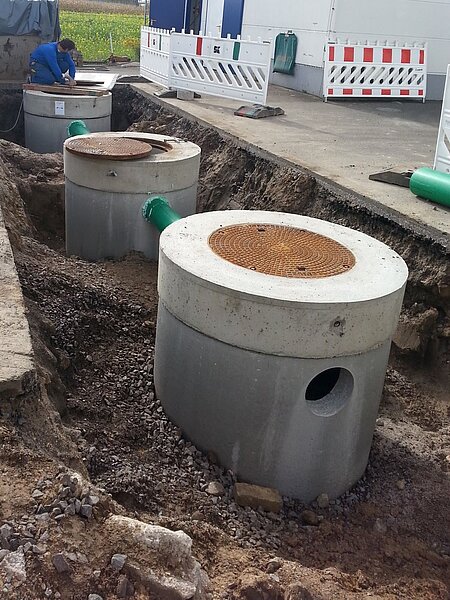
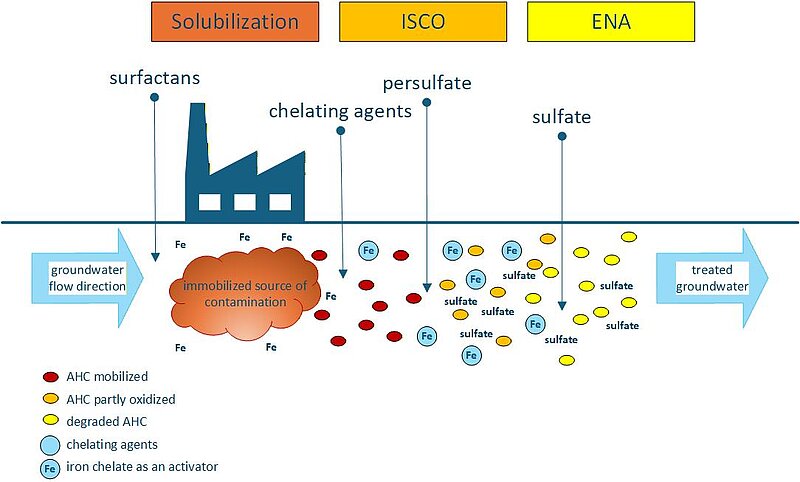
At the TZW, a method for anaerobic stimulation of AHC degradation using sulfate as an electron acceptor (Enhanced Natural Attenuation = ENA) has already been successfully developed and implemented through infiltration into large-volume wells (Figure 1). In this project, sulfate-reducing degradation is to be combined with upstream in-situ chemical oxidation (ISCO) for the accelerated treatment of the contamination source. To this end, the contaminants in the contamination source are first mobilized using surfactants (solubilization) and then oxidized with activated persulfate (ISCO). Activation is achieved using ferrous iron already present in the subsurface, which remains available for the activated oxidation step through the addition of chelating agents. Subsequently, the oxidized AHCs are degraded by sulfate-reducing bacteria naturally present in the aquifer (ENA) (Figure 2). In this combined process, the dosing of sulfate to stimulate degradation is not necessary, as sulfate is already formed during AHC oxidation from the decomposition of the persulfate and flows into the bioactive zone. This approach enhances cost-efficiency. At the same time, the combined process enables versatile and targeted application, for example, even on hard-to-access, developed remediation sites.
The anaerobic sulfate-reducing bacteria in the downstream zone are highly sensitive to oxygen. It is therefore essential to ensure that anaerobic conditions prevail in the bioactive zone so that the anaerobic bacteria can survive and degrade the oxidized pollutants.
For targeted process control, it is therefore particularly essential to monitor the critical transition zone between the oxidized and anaerobic, bioactive zones. To this end, methods already in use at the TZW are being further developed as part of this project.
The goal is to use flow cytometry to develop a method for detecting live and dead microorganisms, including anaerobic ones. Corresponding detection methods for aerobic bacteria have already been developed at the TZW.
Another method already developed at the TZW is the detection of the functional dsr gene using polymerase chain reaction (PCR). The functional dsr gene encodes the genetic information for the potential formation of the enzyme dissimilatory sulfite reductase and represents a key enzyme for sulfate-reducing metabolism. However, to detect sulfate-reducing metabolic activity or its potential inhibition/damage, the detection and quantification of messenger RNA (mRNA) is also required. mRNA transmits the genetic code from DNA and is produced only when the key enzyme for sulfate-reducing degradation is synthesized in the ribosomes.
Extensive batch and column tests complement the laboratory development phase and are used to tailor the process development and parameterization for application at the AHC-contaminated site. If successfully established, the combined process could in principle also be applied at other sites.
Publications
Müller A., Schell H., Stange C., Willmann A., Schmid K.-H., Tiehm A. (2020): Stimulierung des Abbaus von Monoaromaten mit Sulfat. In: Kursunterlagen zum Seminar 02/2020 „Natural Attenuation (NA) in der Praxis der Altlastenbearbeitung“, Fortbildungsverbund Boden und Altlasten Baden-Württemberg, Karlsruhe 08. Okt. 2020: 4/1-4/27
Müller A., Stange C., Tiehm A. (2018): Neue molekularbiologische Methoden zum Nachweis des anaeroben BTEX-Abbaus. In: Kursunterlagen zum Seminar 01/2018 „Natural Attenuation (NA) in der Praxis der Altlastenbearbeitung“, Fortbildungsverbund Boden und Altlasten Baden-Württemberg, Karlsruhe 01. Feb 2018: 4/1-4/13
Müller, A.; Tiehm, A. (2024): Natural Attenuation (NA) und Stimulation des Bioabbaus (ENA) in der Praxis der Altlastenbearbeitung. In: Kursunterlagen zum Seminar ALTLASTEN 2024 „Aus Altlasten lernen - von der Altlastensanierung zum vorsorgenden Boden- und Grundwasserschutz“, Arbeitskreis Grundwasserschutz e.V., Industrie- und Handelskammer (IHK), Karlsruhe 19./20. Juni 2024, 8 Seiten
Salowsky, H.; Schäfer, W.; Schneider, A.-L.; Müller, A.; Dreher, C.; Tiehm, A. (2021): Beneficial effects of dynamic groundwater flow and redox conditions on Natural Attenuation of mono-, poly-, and NSO-heterocyclic hydrocarbons. Journal of Contaminant Hydrology 243: 103883