


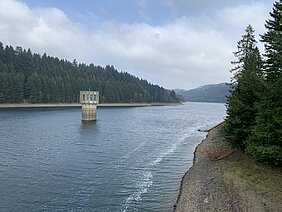
As a result of climate change, variations in the raw water quality from reservoirs are occuring, which must be addressed through appropriate treatment processes (adaptions) if used for drinking water production. As part of this project, an assessment is being conducted on how to minimize the levels of biodegradable organic substances in the water.
In recent years, extreme weather events in Germany have increased in both intensity and frequency. In addition to the amount of available water, the consequences for water treatment plants using raw water from reservoirs are evident in changes to water quality. Among other things, an increase in humic substance levels and a more frequent occurrence of algal blooms—associated with the release of algal-derived substances—have been observed in some reservoirs, which has a negative impact on raw water quality.
Among several factors, DOC contributes to the formation of disinfection byproducts. If the water still contains degradable organic matter at the end of the treatment process, disinfection—in addition to its desired effect of inactivating microorganisms—can lead to the formation of byproducts that might cause increased bacterial growth in the distribution system.
To address climate change, measures are needed not only prior to water extraction but also through the use of appropriate treatment technologies that can consistently provide safe drinking water even as raw water quality changes. The goal must be to minimize the levels of readily degradable organic compounds (assimilable organic carbon, AOC) at the end of the treatment process to such an extent that bacterial growth does not occur in the distribution system even without residual disinfectants (biologically stable water).
Some water treatment plants use relatively new treatment processes for optimized particles removal, such as micro- and ultrafiltration including the prior addition of coagulants. To date, it is unclear to what extent the treatment techniques (including conventional and new processes) can ensure sufficient removal of natural organic water constituents and deliver drinking water that remains microbiologically safe throughout the distribution system. Changes in water quality due to climate change increase this uncertainty.
Therefore, as part of this research project, the various options for reservoir water treatment are being evaluated in terms of their ability to remove natural organic constituents from the water, particularly biodegradable substances, as well as their potential to form byproducts during disinfection. The treatment processes considered in this regard include at least the following alternatives:
- Conventional treatment by flocculation and filtration
- Ultrafiltration (UF) (typically with coagulant dosing at the inlet; used at different stages in the treatment process)
- Treatment, including ozonation and activated carbon filtration
- Various disinfection methods as the final stage (Cl2, ClO2, UV, or combinations)