

Soil and groundwater in the Rastatt/Baden-Baden area are contaminated with PFAS over a wide area. To ensure the long-term availability of drinking water and the continued use of agricultural land in the region, remediation strategies that are both economically and ecologically sound are essential.
The collaborative project between the Research Facility for Subsurface Remediation (VEGAS) at the University o0f Stuttgart and TZW is investigating three different approaches to removing PFAS from contaminated soils:
In-situ thermal remediation aims to achieve desorption and transformation of PFAS by raising the temperature and adding various additives. To prepare for a subsequent field trial, the process parameters are first optimized on a laboratory scale. In this subproject, TZW is applying its analytical expertise to identify and quantify the potentially formed transformation products.
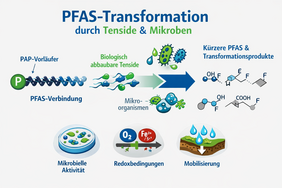
The second subproject, which is being conducted entirely at TZW, focuses on the transformation and mobilization of PFAS. The use of biodegradable surfactants is intended to promote the biological transformation of PFAS on the one hand and increase the mobility of the compounds on the other. A key component of this subproject is also the identification and quantification of the resulting transformation products. In addition, microbiological and molecular biological analyses provide important information on the biological activity and composition of microbial communities. In this way, the aim is to specifically expand our understanding of PFAS transformation processes under different redox conditions.
The third subproject investigates the accumulation of PFAS in the transition zone between the unsaturated and saturated soil. The goal is to translate this effect into a technical process for PFAS removal, for example, using appropriately installed drainage pipes.