

ValidReuse develops practical validation procedures, SOPs, and evaluation methods for safe water reuse and future reference facilities.
Water is a vital resource for cities and agriculture. At the same time, droughts, conflicts over water use, and pressure on existing water resources are on the rise. The reuse of treated wastewater can tap into additional water resources, relieve pressure on natural water bodies, and create new opportunities for irrigation and other uses. This requires that the treatment process functions reliably and that microbiological risks are safely managed.
Regulation (EU) 2020/741 and the technical standard DWA-M 1200 specify requirements for water reuse. For certain quality classes, it must be demonstrated that treatment processes sufficiently reduce bacteria, viruses, and protozoa. This verification is carried out through process validation using microbiological indicators such as E. coli, coliphages, and spore-forming organisms. In practice, this is challenging: viral indicators and spores, in particular, often occur in raw wastewater at concentrations that are insufficient for robust quantitative verification of the required log reductions. Therefore, methods such as spiking or the enrichment of large sample volumes are required. These procedures are methodologically complex and have not yet been sufficiently standardized.
This is where the ValidReuse research project comes in. The project is an indirect continuation of the Nutzwasser project and addresses key questions that have emerged from previous work on water reuse. The goal is to refine validation methods, test them in practice, and translate them into recommendations for operators, authorities, and expert committees. To this end, best-practice recommendations and standard operating procedures for spiking and enrichment methods are developed, recovery rates are determined, and statistical evaluation approaches are devised. The methods are being applied at three real-world treatment plants to evaluate the performance of various treatment chains and to prepare the first reference plants in accordance with DWA-M 1200.
A key component is the concept of reference plants. Treatment chains that have been comprehensively validated and described under defined operating conditions can serve in the future as a basis for simplified follow-up validations of comparable plants. This is intended to facilitate approval and planning processes, reduce the validation effort, and accelerate the implementation of water reuse projects. At the same time, the results provide a scientific basis for the further development of DWA-M 1200 from the draft version to the final version.
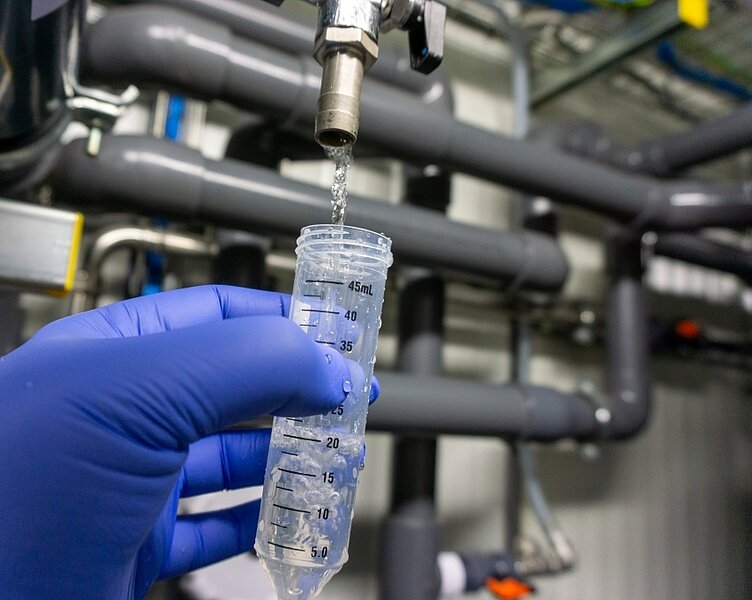
In this project, the TZW is primarily responsible for coordinating the laboratory aspects of the spiking experiments at the Schweinfurt site, conducting microbiological analyses of the validation parameters, and examining spiked samples from the treatment chains in Schweinfurt, Bad Oeynhausen, and Glessen. In addition, the TZW supports the development of SOPs for spiking and enrichment procedures and the evaluation of recovery rates.
Through ValidReuse, the TZW is helping to make water reuse in Germany safer, more predictable, and faster to implement. The results are intended to standardize microbiological validations, make regulatory requirements more practical, and advance the use of alternative water resources on a scientifically sound basis.
Publications
Ho, J.; Stange, C.; Diadko, D.; Eghbaria, Y.; Nasser, A.; Tiehm, A. (2025): Elimination of antibiotic resistances, pathogens and faecal indicators in advanced wastewater treatment. In: 22nd Health Related Water Microbiology Conference (HRWM), Amersfoort, the Netherlands, 15.-20. June 2025, Book of abstracts, Oral Presentation
Nasser, A.; Eghbaria, Y.; Stange, C., Tiehm, A. (2025): Combined disinfection processes for the reduction of microbial indicators and antibiotic resistant genes from wastewater effluents. In: 22nd Health Related Water Microbiology Conference (HRWM), Amersfoort, the Netherlands, 15.-20. June 2025, Book of abstracts, Oral Presentation
Sauter, D.; Stange, C.; Schumacher, V.; Tiehm, A.; Gnirss, R.; Wintgens, T. (2021): Impact of ozonation and biological post-treatment of municipal wastewater on microbiological quality parameters.
Environmental Science Water Research & Technology 7, 9: 1643–1656, DOI: 10.1039/D1EW00312G
Ho, J.; Schweikart, C.; Stange, C.; Tiehm, A.; Ahmadi, J.; Thiel, M.; Aumeier, B.; Drewes, J.E.; Buettner, M.; Scheyer, N.; Baumann, L. (2026): Mikrobiologische Barrierewirkung moderner Wasserwiederverwendungs-systeme zur mikrobiologischen Sicherheit bewässerter Pflanzen. In: Gewässerschutz - Wasser - Abwasser (GWA) 261 51/1-51/9
Ho, J.; Ahmadi, J.; Stange, C.; Schweikart, C.; Drewes, J.E.; Tiehm, A. (2025): Microbial safety and antibiotic resistance of crops after irrigation with reclaimed water. Water Reuse 15 (2), 300–318, DOI: 10.2166/wrd.2025.030
Ho, J.; Ahmadi, J.; Schweikart, C.; Hübner, U.; Schwaller, C.; Tiehm. A.; Drewes, J.E. (2024): Assuring reclaimed water quality using a multi-barrier treatment train according to the new EU non-potable water reuse regulation.
Water Research 267: 122429, DOI: 10.1016/j.watres.2024.122429