


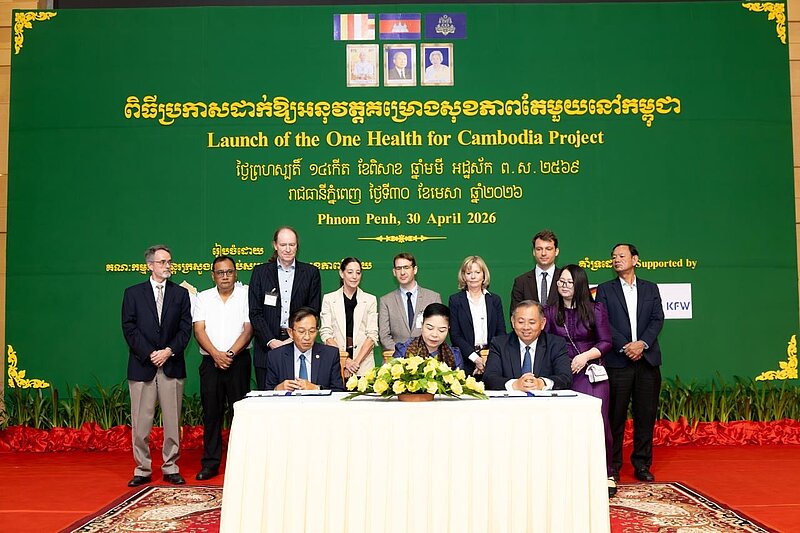
OH4CAM strengthens One Health in Cambodia. As the Environmental Health partner, TZW supports the development of laboratory capacities as well as the establishment of environmental monitoring for antimicrobial resistance and infectious pathogens.
The OH4CAM project – One Health for Cambodia – supports the development of a comprehensive and sustainably usable One Health framework in Cambodia. Its focus lies on the prevention, detection, and control of antimicrobial resistance, zoonotic diseases, and emerging infectious diseases. The One Health approach integrates human, animal, and environmental health, creating structures for cross-sectoral collaboration, reliable data generation, and coordinated responses to health risks.
In recent years, Cambodia has established initial national One Health structures, including technical working groups within the responsible ministries and an Interministerial Coordination Committee for One Health (IMCC-OH). The OH4CAM project builds on these foundations and strengthens collaboration between the Ministry of Health (MoH), the Ministry of Agriculture, Forestry and Fisheries (MAFF), and the Ministry of Environment (MoE).
The project is supported by German expert institutions: the Robert Koch Institute for the human health component, the Friedrich Loeffler Institute for animal health, and TZW: DVGW-Technologiezentrum Wasser as the Environmental Health Partner of the MoE. This close cooperation enables the integration of data and a holistic approach to addressing health challenges.
TZW contributes its expertise in environmental microbiology, water analytics, molecular diagnostics, and antimicrobial resistance (AMR) monitoring in environmental matrices. A key focus is the development of capacities for environmental surveillance, particularly in aquatic environments, municipal wastewater, hospital effluent, and wastewater from animal markets and slaughterhouses. Such environmental samples can provide valuable insights into the spread of resistant bacteria, resistance genes, and other infectious pathogens, thereby supporting early detection and risk management in line with the One Health concept.
In collaboration with the MoE and other project partners, TZW develops standard operating procedures and technical guidelines for microbiological and molecular environmental analyses. In addition, TZW supports the planning and further development of laboratory infrastructures, promotes knowledge transfer through training and workshops, and contributes to the implementation of selected research and surveillance activities.
Through its role in OH4CAM, TZW strengthens the environmental dimension of the One Health approach and helps establish water and wastewater analysis as key components of integrated health protection. The goal is to build a long-term partnership with Cambodian institutions, enhancing local expertise, fostering sustainable laboratory and monitoring structures, and supporting evidence-based decision-making to protect human, animal, and environmental health.
Publications:
Stange, C.; Kalyetsi, R.; Owokuhaisa, J.; Ntaro, M.; Leon, A.; Hunter, P.; Tiehm, A.; Mulogo, E. (2025): Monitoring of antimicrobial resistance in hospital, municipal, and treated wastewater in Mbarara, Uganda. Journal of global antimicrobial resistance 45, 100–106, DOI: 10.1016/j.jgar.2025.09.002
Ho, J.; Stange, C.; Suhrborg, R.; Wurzbacher, C.; Drewes, J.E.; Tiehm, A. (2022): SARS-CoV-2 wastewater surveillance in Germany: Long-term RT-digital droplet PCR monitoring, suitability of primer/probe combinations and biomarker stability. Water research 210: 117977, DOI: 10.1016/j.watres.2021.117977
Voigt, A.M.; Zacharias, N.; Timm, C.; Wasser, F.; Sib, E.; Skutlarek, D.; Parcina, M.; Schmithausen, R.M.; Schwartz, T.; Hembach, N.; Tiehm, A.; Stange, C.; Engelhart, S.; Bierbaum, G.; Kistemann, T.; Exner, M.; Faerber, H.A.; Schreiber, C. (2020): Association between antibiotic residues, antibiotic resistant bacteria and antibiotic resistance genes in anthropogenic wastewater - An evaluation of clinical influences. Chemosphere 241: 125032, DOI: 10.1016/j.chemosphere.2019.125032
Stange, C.; Yin, D.; Xu, T.; Guo, X.; Schäfer, C.; Tiehm, A. (2019): Distribution of clinically relevant antibiotic resistance genes in Lake Tai, China. Science of the total environment 655: 337–346, DOI: 10.1016/j.scitotenv.2018.11.211