





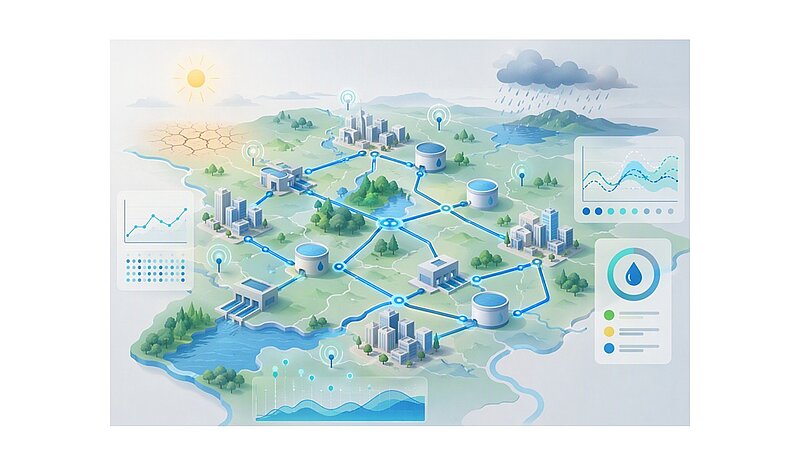
ResilVerbund develops digital tools for resilient drinking water distribution networks. Forecasting models, simulations and a central data portal enhance supply security and support sustainable water resource management.
The effects of climate change are increasingly presenting new challenges for public drinking water supply. Hot and dry summers can lead to falling groundwater levels and reduced spring flow; at the same time, periods of heavy rainfall are on the rise. This is increasing the need to plan regional supply structures and supra-regional network systems with foresight, to utilise them flexibly in the event of shortages, and to systematically assess their stability.
The ResilVerbund collaborative project is using the Lake Constance water supply as a case study to investigate how interconnected systems can contribute to security of supply, both on a long-term basis and in emergency situations. The aim is to strengthen the resilience of the drinking water supply and, for the first time, to make it possible to systematically assess and specifically improve the stability of an entire interconnected system. To this end, the project participants are developing digital resilience tools, new cooperation models and improved monitoring.
At the heart of the project is a network-wide knowledge and data portal. It is designed to facilitate the exchange of measurement data, forecasts and simulation results via standardised digital interfaces, to visualise data clearly, and to centrally collate specialist knowledge and documents. In addition, models for forecasting water demand in the Lake Constance water supply catchment area are being developed. These forecasts are intended to cover various time horizons – from short-term operational and supply planning to the long-term strategic adaptation of the infrastructure.
Another key focus is the development of a hydraulic integrated simulation model that jointly maps municipal networks, regional transport systems and interconnections. This will reveal where reserves exist within the overall system and where potential bottlenecks may arise. Technical indicators are derived from the simulations and fed into a novel resilience traffic light system. This is designed to clearly indicate the system’s status and support decisions on appropriate countermeasures.
The tools developed are being applied and tested in the Lake Constance water supply system. Practical application within a large long-distance water supply system is yielding solutions that can also be transferred to other interconnected network operators. As the data portal is designed using freely available software, it should be easy to use and cost-effective for operators to set up. In this way, ResilVerbund makes a contribution to the further development of water supply in Germany in a climate-resilient, digitally supported and collaborative manner.
